

Open the door of a Rolls Royce Cullinan that has spent six months in Dubai without a professional interior detail, and the condition of the cabin will not reflect the condition of the car. The leather will have started to fade and stiffen. The dashboard plastics will carry a fine film of settled dust that re-suspends every time the air conditioning is switched on. The carpets will have taken on a smell that no air freshener can address. And the air vents will be circulating that same interior air — including the skin oils, food particles, and bacteria that have been accumulating in the cabin since the last proper clean.
Interior detailing is not about appearances alone. In Dubai’s climate — where cabin temperatures can exceed 70°C in direct sun, where the air conditioning runs for nine months of the year, and where fine desert dust penetrates every seal — the interior of an undetailed car is a genuinely unhealthy environment. A professional interior detail addresses all of it.
ℹ️ Quick Overview
This guide covers every aspect of professional interior car detailing in Dubai — from what actually happens during a full detail to how different interior materials require different products and approaches. We have written it specifically for owners of luxury and exotic vehicles in the UAE.
Why Interior Detailing Is Critical in Dubai
Interior detailing is important everywhere. In Dubai, it is more important than in almost any other city in the world — for four specific reasons that are unique to this environment.
1. Extreme Cabin Temperature
A car parked in direct sun in Dubai in July can reach internal cabin temperatures exceeding 70°C. At this temperature, leather cracks, plastics off-gas, fabric fibres break down prematurely, and any moisture trapped in carpets or upholstery bakes into permanent stains and odours. The heat accelerates the degradation of every interior material simultaneously — and it does so every single day during the summer months.
2. Year-Round Air Conditioning
Dubai’s climate means the air conditioning runs for the majority of the year. A vehicle’s HVAC system continuously recirculates cabin air — and with it, any particulates, bacteria, and odour sources that have accumulated in the cabin. Blocked or dirty air vents distribute contaminated air throughout the interior on every journey. Over time, the air conditioning evaporator itself becomes a breeding ground for mould and bacteria that produce the musty smell so common in heavily used vehicles in humid climates.
3. Desert Dust Penetration
Dubai’s desert environment means ultrafine sand and dust particles are constantly present in the air. These particles are small enough to pass through door seals and window gaps — settling on every horizontal surface inside the cabin. On an Alcantara headliner, this dust embeds into the fibres. On a leather seat, it works into the grain and acts as a mild abrasive every time someone sits down. On dashboard plastic, it builds into a greasy film under the heat of the sun.
4. UV Degradation of Interior Materials
Dubai’s UV index reaches 11+ in summer — classified as Extreme. Sunlight entering through the windows degrades interior materials at an accelerated rate compared to temperate climates. Leather fades and loses suppleness. Plastics become brittle and develop a hazy, chalky surface. Dashboard sections that receive direct sun through the windscreen show visible degradation within a few years on unprotected vehicles.
💡 Key Insight
In Dubai’s climate, a luxury vehicle’s interior is under constant stress that simply does not exist in European or North American conditions. Professional interior detailing every 3 to 4 months is not excessive — it is the minimum required to maintain the cabin in the condition that reflects the vehicle’s value.

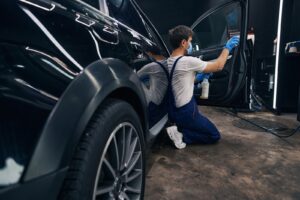
Professional interior detailing at Kartal Auto’s Dubai workshop — every surface addressed under controlled conditions.
What Interior Detailing Actually Involves
Interior detailing is not vacuuming and a wipe-down. A professional interior detail on a luxury vehicle is a systematic, multi-surface process that addresses every surface of the cabin — inside the door shuts, inside every storage compartment, underneath and between the seats, the seatbelt webbing, the headliner, the sun visors, and every air vent.
Here is what a professional interior detail actually covers, in order:
01
Full Vacuuming
Carpets, floor mats, under seats, seat rails, door pockets, boot floor, and all storage areas vacuumed using a professional vacuum with the correct attachments for each zone. Seats moved forward and back to access all carpet areas. Small crevice tools for seams, seat stitching, and console gaps.
02
Leather Cleaning & Conditioning
Seats, door cards, centre console leather, and steering wheel leather cleaned with pH-neutral leather cleaner applied with a soft brush. Ground-in soiling and body oil removed from grain and stitching. Conditioner applied to restore suppleness and provide UV protection.
03
Steam Cleaning — Fabric & Alcantara
Steam cleaning applied to fabric headliners, Alcantara surfaces, carpet sections, and fabric seat bolsters. Steam lifts embedded contamination and kills bacteria without saturating the material. Brush agitation with a soft detailing brush during steam application for deeper cleaning of pile fibres.
04
Dashboard & Hard Surface Detailing
Dashboard, centre console, door panels, and all plastic and rubber surfaces cleaned with appropriate interior cleaner. Every gap, seam, and joint cleaned with detailing brushes. Switches, buttons, and controls cleaned individually. All surfaces dressed with a UV-protective product at appropriate sheen level.
05
Air Vent Cleaning
Every air vent blade and opening cleaned with a detailing brush. Compressed air used to dislodge dust from inside the vent housing. Interior cabin filter inspected and replaced if heavily contaminated. This step alone makes a noticeable difference to air quality inside the cabin.
06
Interior Glass & Mirrors
Windscreen interior, all side windows, rear screen, and interior mirrors cleaned using professional glass-specific products. Anti-static solution applied to reduce dust reattachment. Interior glass cleaned last to avoid overspray contamination from earlier stages.
07
Odour Elimination
Ozone treatment or specialist cabin odour eliminator applied after cleaning to neutralise any remaining odour sources. Not a masking fragrance — an odour-eliminating treatment that breaks down the organic compounds causing the smell at their source.
08
Final Inspection
Every surface and zone inspected before the vehicle is returned. Any missed areas, residue, or spots addressed. Boot area cleaned and re-lined where mats are present. Door shuts and sill plates wiped. The vehicle returned in a condition that reflects the standard of the work carried out.
Leather Care: The Most Important Interior Surface
Leather is the primary interior surface in the majority of luxury vehicles — and it is the surface that deteriorates most visibly when neglected in Dubai’s climate. The combination of heat, UV exposure, and the repeated contact of skin oils, perspiration, and sunscreen creates a set of stresses on leather that are genuinely unique to this environment.
“Leather is not just a material — it is a living surface that responds directly to how it is treated. In Dubai, doing nothing is the most damaging choice a car owner can make.”
How Dubai’s Climate Damages Leather
At cabin temperatures above 60°C, the natural oils that give leather its suppleness begin to evaporate. The leather becomes stiffer, loses its smooth hand feel, and the surface begins to crack — first along the seat creases under the primary contact points, then more broadly across the seat bolsters and side bolstering.
UV light bleaches the dye in the leather surface. On darker colours, this appears as a greying or lightening of the most sun-exposed areas — typically the driver’s side of the dashboard-facing seat areas and the top of the steering wheel. On lighter colours, it appears as a yellowing or dulling of the originally bright tone.
Sunscreen and body lotion — almost universally worn in Dubai — contain chemical compounds that actively break down leather dye and surface coatings. A leather steering wheel used daily by hands covered in SPF50 sunscreen will show accelerated dye loss and surface degradation within a year without regular proper cleaning.
How to Clean Leather Correctly
Leather cleaning requires a pH-neutral leather cleaner — not an all-purpose interior cleaner, not a household detergent, and not baby wipes. These products strip the natural oils from leather, leave residue in the grain, or alter the surface pH in ways that accelerate deterioration.
⚠️ Do Not Use These on Leather
Baby wipes, all-purpose cleaners, bleach-based products, alcohol wipes, washing-up liquid, and household glass cleaners — all of these damage leather over time. Baby wipes in particular are one of the most common causes of leather deterioration we see in Dubai vehicles. They feel harmless and clean effectively short-term, but they contain surfactants and preservatives that damage the leather surface with repeated use.
The correct process for leather cleaning is: product applied to a soft microfibre cloth or a leather cleaning brush, worked gently into the surface in small sections, wiped off with a clean cloth, and repeated until the cloth comes back clean. On heavily soiled seats, a soft detailing brush agitates product into the grain and stitching.
Why Conditioning Is Non-Negotiable in Dubai
Leather conditioner replenishes the oils that Dubai’s heat evaporates from the leather surface. It is not optional — it is the step that determines whether your leather retains its suppleness or cracks. A conditioner should be applied after every cleaning session and as a standalone maintenance treatment at least once every 3 months in Dubai’s climate.
The conditioner also provides a barrier against UV degradation and chemical attack from sunscreen. A conditioned leather surface resists the dye-stripping effects of SPF products significantly better than unconditioned leather.
| Leather Type | Cleaning Approach | Conditioning Frequency | Dubai Vulnerability |
|---|---|---|---|
| Standard Leather | pH-neutral cleaner, soft cloth | Every 3 months | Moderate — responds well to conditioning |
| Nappa Leather | pH-neutral cleaner only, very gentle | Every 2 months | High — softer surface, more vulnerable to heat |
| Perforated Leather | Light spray application, avoid saturation | Every 2–3 months | High — perforations trap dust and oils |
| Bi-Cast / Faux Leather | Mild cleaner, no conditioner needed | Not required | Very high — delaminates in extreme heat |
Alcantara & Fabric: Different Rules, Different Products
Alcantara is the premium synthetic suede used in the interiors of Lamborghini, Ferrari, Porsche, and various AMG and M Performance vehicles. It looks and feels like suede, but its care requirements are completely different from both standard fabric and leather.
What Makes Alcantara Different
Alcantara is a microfibre-based material — the fibres are finer than natural suede and more sensitive to the wrong cleaning products. The most common mistake in Alcantara care is applying any product that is oil-based — including most leather conditioners — which causes the fibres to mat and lose their characteristic soft, raised texture permanently.
In Dubai, Alcantara headliners and seat bolsters attract desert dust more aggressively than smooth surfaces, because the raised fibre surface acts as a trap for fine particles. On a vehicle used regularly during dusty weather, an Alcantara headliner can accumulate a visible grey layer within weeks.
Correct Alcantara Cleaning
Alcantara should be cleaned using a specialist Alcantara cleaner or a very mild fabric cleaner applied sparingly with a soft-bristle brush. The product is worked in with light circular strokes — always finishing in the direction of the pile to restore the fibres to a consistent direction. The area is then blotted with a clean microfibre cloth, never rubbed.
Steam cleaning is the best method for deeply contaminated Alcantara — the steam softens and lifts embedded particles without saturating the material or leaving residue. It is also the safest method for removing odours from Alcantara without the risk of water marking.
💡 Pro Tip
Never use a stiff brush on Alcantara — it permanently damages the fibre structure. Never use a leather conditioner or any oil-based product on Alcantara — it mats the fibres irreversibly. If in any doubt about the correct product for your specific Alcantara, bring the vehicle to a professional rather than risk permanent damage to an expensive surface.
Standard Fabric Upholstery
Standard fabric seats — less common in luxury vehicles but present on many SUVs and saloons — are the most forgiving interior surface to clean. Fabric seats accept a wider range of products and techniques than leather or Alcantara. The primary approach is steam cleaning combined with a fabric-safe upholstery cleaner and a medium-bristle brush. Heavier staining may require a specialist extraction cleaning process.
After cleaning, a fabric protector spray can be applied to treated fabric surfaces — creating a barrier that causes future liquid spills to bead and sit on the surface rather than being absorbed. In Dubai’s environment, this is a worthwhile step for any fabric-seated vehicle.
Carpets, Floor Mats & Headliner
Carpets
Car carpets in Dubai accumulate desert sand at a rate that owners of vehicles in cooler climates would not recognise. Sand enters on shoes, it falls from clothing, and it drifts in through door gaps during windy conditions. The fine sand particles work down through the carpet pile and into the backing — where standard vacuuming cannot reach without agitation.
A professional carpet clean requires vacuuming with brush agitation to dislodge embedded particles from the pile, followed by a spray application of an appropriate carpet cleaner, a stiff-bristle brush scrub, and then either hot water extraction or steam cleaning to lift the product and the contamination out of the fibres. Carpets are then dried thoroughly — essential, because damp carpet in Dubai’s heat becomes a mould risk within 24 hours.
Floor Mats
Rubber floor mats — common in UAE vehicles as a practical dust and sand management measure — can be removed, pressure washed, and dried quickly. Fitted carpet mats require the same treatment as the vehicle carpets themselves. Floor mats should always be removed for cleaning rather than cleaned in place, so the carpet underneath can be addressed simultaneously.
Headliner
The headliner is one of the most commonly neglected interior surfaces — and one of the most easily damaged by incorrect cleaning. Most factory headliners use a fabric-backed foam that is glued to the roof panel. Saturating the headliner with cleaning product dissolves the adhesive, causing the headliner to sag and drop — an expensive repair that far exceeds the cost of a professional clean.
Headliners should be cleaned using steam only — no liquid products, no scrubbing with wet cloths. The steam is applied in short passes, the condensate lightly blotted with a clean microfibre, and the surface allowed to dry fully. Spot staining on headliners — the most common being sunscreen transferred from hands — requires targeted treatment with a very small amount of upholstery cleaner applied on a damp cloth, not sprayed.
⚠️ Common Headliner Mistake
Spraying any liquid product directly onto a car headliner is one of the most common causes of headliner sag we see in Dubai workshops. Always apply product to the cloth, never spray the headliner directly. Better still — leave headliner cleaning to a professional the first time to understand the material’s limits before attempting it yourself.
Dashboard, Plastics & Centre Console
The dashboard is the interior surface most exposed to Dubai’s UV radiation — and the surface that shows the earliest visible degradation on unprotected vehicles. Dashboard plastic degrades from UV exposure in two ways: the surface develops a greasy film from the off-gassing of the plastic itself, and the colour begins to fade or yellow in sections with direct sun exposure through the windscreen.
Cleaning Approach
Dashboard and interior plastic surfaces should be cleaned with a mild interior detailing spray applied to a microfibre cloth — never sprayed directly onto the surface, which risks product entering the instrument cluster, air vents, or electrical switches. Every gap, switch housing, and button surround is addressed individually with a detailing brush to remove accumulated dust.
Dressing and Protection
After cleaning, a UV-protective interior dressing should be applied to all plastic and vinyl surfaces. The sheen level of the dressing matters — an incorrect glossy dressing on a matte dashboard creates an unpleasant glare reflection on the windscreen during driving. Most modern luxury vehicles use a satin or matte dashboard finish, requiring a low-sheen or zero-sheen dressing. Check the factory finish before applying any product.
✦ The Right Sheen Matters
A glossy interior dressing applied to a matte dashboard reflects in the windscreen during daytime driving — particularly against Dubai’s bright skies. Always match the dressing sheen to the factory finish. Matte surfaces need matte dressing. Satin surfaces need a satin product. High-gloss should be reserved only for surfaces that are factory gloss.
Centre Console, Gear Selector & Touchscreens
The centre console — particularly around the gear selector, cup holders, and any physical button clusters — is the highest-contact area of the interior. It accumulates oils, drink residue, and general soiling rapidly. Physical buttons and rotary switches require detailing brush cleaning before the surrounding surface is wiped, to dislodge built-up grime from around the switch housing.
Touchscreens should be cleaned with a dry microfibre only — no product — unless a specialist screen-safe product is available. Any moisture entering the edges of a touchscreen display housing can cause permanent display damage or electrical issues.
Interior Glass & Window Cleaning
Interior glass is one of the most neglected surfaces in car cleaning — and one of the most immediately noticeable when it is properly done. Interior glass accumulates a film of off-gassed compounds from plastic and vinyl surfaces — this is the same process that creates the “new car smell” in a recently delivered vehicle, but over time it creates a greasy, hazy film on the interior of the glass.
This film scatters incoming light — particularly the low-angle sun that is characteristic of Dubai’s morning and evening drive conditions — creating a dangerous glare effect that significantly reduces forward visibility. A properly cleaned interior windscreen is a genuine safety improvement, not simply a cosmetic one.
Correct Interior Glass Cleaning
Interior glass requires a dedicated glass-specific cleaner — not all-purpose spray. The glass is cleaned with two cloths: one damp with cleaner, one dry for buffing. The buffing stage removes the cleaning product residue that would otherwise create a new haze. Interior glass should always be cleaned last during a detail session — after all other surfaces — to avoid overspray from leather conditioner, dressings, or upholstery products landing on freshly cleaned glass.
Anti-static glass cleaner is the preferred product for interior glass — it reduces the static charge on the glass surface that would otherwise attract settled dust back almost immediately after cleaning. In Dubai’s dusty environment, this makes a significant difference to how long the clean glass stays clean.
Air Vents & HVAC Cleaning
Air vents are almost universally overlooked in routine car cleaning — and in Dubai, their condition directly affects the air quality inside the cabin. Every time the air conditioning or heating system runs, air passes through or over the vent blades and the accumulated dust, fibres, and contamination that has gathered on them is distributed into the cabin breathing air.
Surface Vent Cleaning
Visible vent blades and surrounds should be cleaned using a fine detailing brush — the same type used for paint defect work or electronic component cleaning — which is soft enough to enter the vent without scratching the surrounding trim. The brush dislodges accumulated dust from between and behind the blades. Compressed air is then used to blow the dislodged dust out of the vent housing before the surrounding trim is wiped.
This process should be carried out before any other interior surface is cleaned — so that the dust expelled from the vents falls onto undetailed surfaces rather than onto freshly cleaned leather or plastic.
HVAC Cabin Filter
The cabin air filter — also called the pollen filter — is the filter that cleans the air drawn into the HVAC system before it enters the cabin. In Dubai’s dusty environment, cabin filters block significantly faster than the manufacturer’s recommended replacement interval, which is typically based on moderate-climate usage. A clogged cabin filter reduces airflow from the HVAC system, causes the air conditioning to work harder, and allows finer particles to pass through into the cabin.
We recommend replacing the cabin air filter at every full interior detail in Dubai — typically every 6 months — regardless of mileage.
💡 Dubai-Specific Advice
If your air conditioning produces a musty or earthy smell when it starts up — particularly after the car has been parked in the sun — the HVAC evaporator has developed mould or bacterial growth. This is common in Dubai due to the humidity that condenses on the cold evaporator surface. An evaporator cleaning treatment (usually a spray applied through the cabin air intake) addresses this and eliminates the smell at its source.
How Often to Detail Your Interior in Dubai
The correct frequency for interior detailing in Dubai depends on three variables: how often the vehicle is used, where it is stored (covered or uncovered parking, garage or outdoor), and the type of interior materials. Here is a practical guide:
| Usage Type | Recommended Frequency | Priority Services |
|---|---|---|
| Daily driver — outdoor parking | Every 6–8 weeks | Leather condition, dust removal, air vents, glass |
| Daily driver — covered parking | Every 3 months | Leather condition, deep clean, carpet |
| Weekend / occasional use | Every 4 months | Full interior deep clean, leather conditioning |
| High-mileage business use | Every 4–6 weeks | Leather, glass, odour treatment, air vents |
| Long-term storage (1–3 months) | On return to use | Full detail, HVAC treatment, leather condition |
| Luxury / exotic vehicle | Every 8–10 weeks regardless of use | Full detail — every surface, every session |
For vehicles with Nappa leather or Alcantara interiors — Rolls Royce, Bentley, Lamborghini, Ferrari — we recommend never extending beyond 10 weeks between full interior details in Dubai. The cost of professional detailing is a fraction of the cost of replacing degraded Nappa leather or a matted Alcantara headliner.
DIY vs Professional Interior Detailing
The question of whether to detail your car interior yourself or use a professional service is one that has a clear answer when the vehicle in question is a Lamborghini, a Rolls Royce, or a Ferrari. The materials in those interiors — Nappa leather, Alcantara, Carbon fibre trim, Piano black lacquered plastics — will not forgive the wrong product or technique. The cost of replacing a damaged Alcantara headliner or a delaminated Piano black trim panel far exceeds the cost of a professional detail.
For standard luxury vehicles — Mercedes, BMW, Range Rover — a careful owner with the right products can maintain their interior between professional sessions. The key word is the right products. Not household cleaners. Not baby wipes. Not the cheapest interior spray available.
“The most expensive interior detail is the one that comes after a DIY cleaning attempt with the wrong products. Nappa leather damaged by an all-purpose cleaner does not come back.”
What Professionals Do That DIY Cannot Replicate
- Steam cleaning equipment that reaches temperatures high enough to genuinely sanitise fabric surfaces and kill bacteria — consumer steam cleaners rarely achieve the dwell time and temperature required
- Paint depth knowledge transferred to interior materials — understanding how far a product can be worked on a specific surface before it risks damage
- Hot water extraction for carpets — the only way to fully remove deep contamination and cleaning product residue from pile fibres
- Ozone treatment for odour elimination — not available as a DIY product in the UAE and genuinely effective where spray fresheners are not
- The time and method required to do the job properly — a full professional interior detail on a luxury vehicle takes 6 to 8 hours. Most DIY efforts take 45 minutes and cover the visible surfaces only
Maintenance Between Professional Details
Between professional detail sessions, there are three things that any luxury car owner in Dubai should do regularly:
Park in shade or use a sunshade: The single most impactful thing you can do to reduce interior degradation in Dubai. Cabin temperature in shade is 20 to 30 degrees lower than in direct sun. At lower temperatures, leather retains its oils, plastics off-gas less, and UV degradation is dramatically reduced.
Weekly dust removal: A microfibre cloth used dry on all hard surfaces removes settled dust before it becomes baked-on film. Takes 10 minutes. Makes a significant difference to how quickly the interior deteriorates between details.
Monthly leather conditioning: A small amount of leather conditioner applied to a cloth and worked into all leather surfaces. Takes 20 minutes. Prevents the cracking that otherwise develops between 3-month professional detail sessions.
How to Protect Paint from Sun Damage
Welcome to WordPress. This is your first post. Edit or delete it, then start writing!
How to Spot Issues in Your Car Engine
Welcome to WordPress. This is your first post. Edit or delete it, then start writing!